PASQuanS2 Wraps Up 2025 with Scientific Milestones and Strong Community Engagement
As 2025 comes to a close, the PASQuanS2 consortium reflects on a year defined by scientific advances, strong collaboration across Europe, and continued engagement with the wider quantum community.
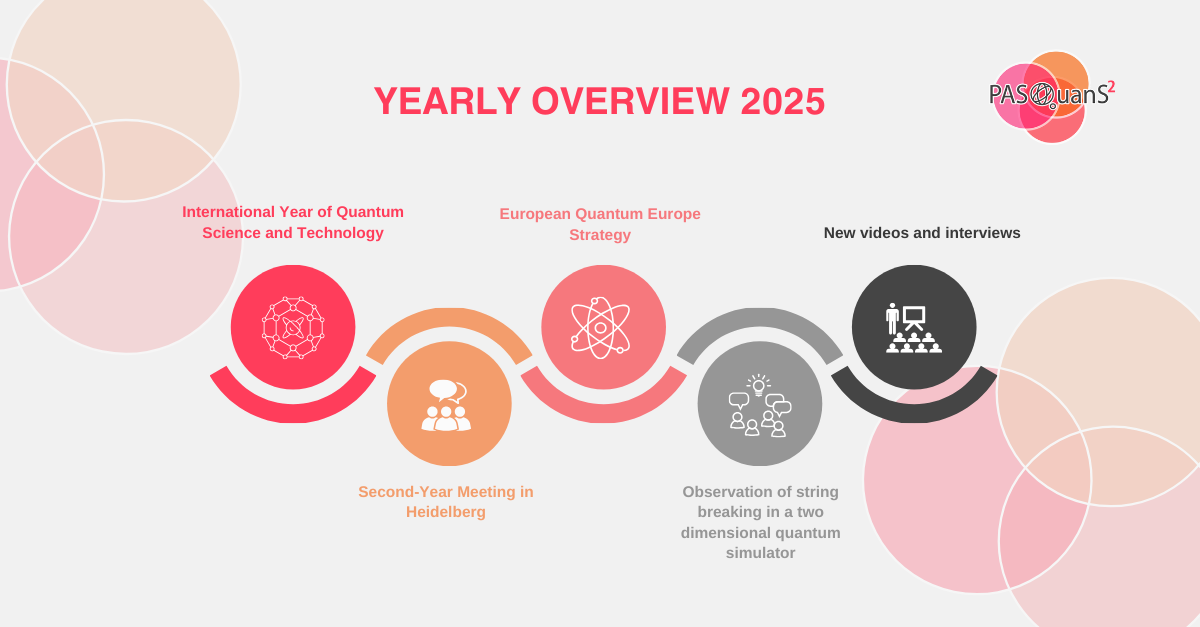
The year began under the banner of the International Year of Quantum Science and Technology, marking 100 years of quantum discoveries. PASQuanS2 joined institutions worldwide in highlighting the importance of quantum research and its growing role in science and technology.
In the spring, partners met in Heidelberg, Germany, for the second annual meeting of the PASQuanS2. The meeting provided an opportunity to review progress across work packages, align technical developments, and strengthen collaboration between academic and industrial partners.
Policy and strategy also featured prominently throughout the year. PASQuanS2 encouraged engagement with the European Commission’s consultation on the future quantum strategy, contributing to discussions on how Europe can continue to strengthen its position in quantum technologies. These activities aligned closely with the adoption of the broader European Quantum Europe Strategy.
Scientific achievements remained at the core of the project. Researchers associated with PASQuanS2 contributed to a significant milestone in quantum simulation with the observation of string breaking in a two dimensional quantum simulator. This result highlights the increasing power and flexibility of programmable quantum simulation platforms and their relevance for fundamental physics.
Alongside research, PASQuanS2 continued to invest in outreach and communication. New videos and interviews, including features on laser technologies with industry partners such as TOPTICA Photonics, offered insight into both the technical foundations of the project and the people behind the research.
Looking back on 2025, PASQuanS2 closes the year with a strong foundation built on scientific results, collaboration, and engagement beyond the consortium. The project now looks ahead to 2026 with momentum and a clear focus on advancing programmable quantum simulation in Europe.